
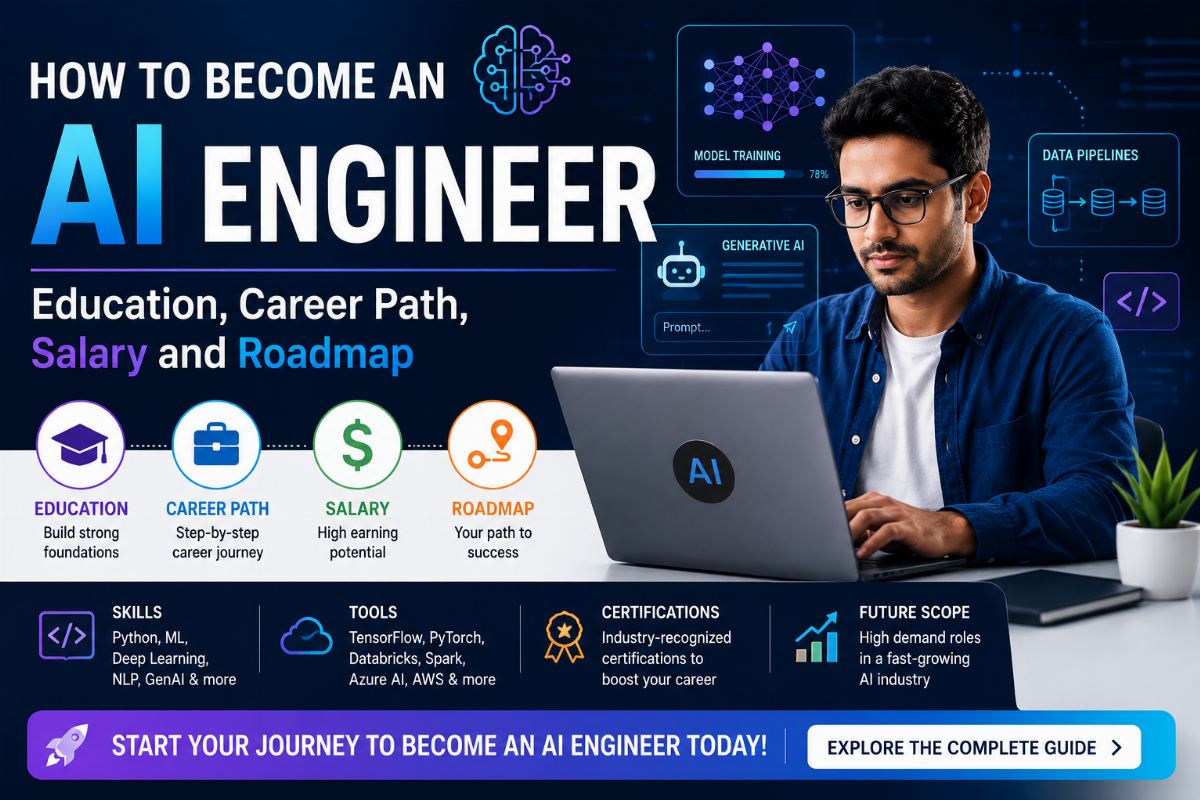
Artificial Intelligence (AI) engineering is transforming industries worldwide, creating unprecedented demand for skilled AI Engineers. From building intelligent chatbots and recommendation systems to developing Generative AI applications and machine learning models, AI Engineers play a critical role in shaping the future of technology.
If you're wondering how to become an AI Engineer, this guide covers everything you need to know—from required skills and certifications to salary expectations and career opportunities.
What Do an AI Engineer Do?
An AI Engineer designs, develops, deploys, and maintains Artificial Intelligence and Machine Learning solutions that help businesses automate processes, improve decision-making, and enhance customer experiences. The given below are typical responsibilities of an engineer…
- Building AI and Machine Learning models
- Developing Generative AI applications
- Training and optimizing algorithms
- Processing and analyzing large datasets
- Deploying AI solutions in production environments
- Integrating AI systems with business applications
- Monitoring model performance and accuracy
- Collaborating with data scientists and software engineers
Why Choose a Career as an AI Engineer?
AI Engineering is one of the fastest-growing technology careers, offering excellent salary potential, exciting challenges, and opportunities to work on cutting-edge innovations.
Benefits of Becoming an AI Engineer:
- High demand across industries
- Attractive salary packages
- Opportunity to work on emerging technologies
- Strong career growth potential
- Global job opportunities
- Remote and hybrid work options
- Ability to solve complex real-world problems
Average Salaries of AI Engineers in USA
AI Engineers are among the highest-paid technology professionals due to the growing demand for AI expertise.
Estimated Annual Salaries of AI Engineers:
|
Experience Level |
Average Salary |
|
Entry-Level |
$90,000 - $125,000 |
|
Mid-Level |
$125,000 - $180,000 |
|
Senior-Level |
$180,000 - $250,000+ |
Compensation may vary depending on location, technical skills, certifications, and industry experience.
[Also Know:
How to Become a Data Scientist: Complete Learning Path, Career Roadmap, Future Scope & Salary]
Skills Required for AI Engineer
AI Engineers require a blend of programming, machine learning, data engineering, and cloud computing skills.
Require Technical Skills:
- Python Programming
- Machine Learning
- Deep Learning
- Generative AI
- Natural Language Processing (NLP)
- Large Language Models (LLMs)
- Data Structures & Algorithms
- Statistics & Mathematics
- SQL
- Data Engineering Fundamentals
- Cloud Computing
- Model Deployment
Require Soft Skills:
- Problem-solving
- Critical thinking
- Communication
- Creativity
- Collaboration
- Continuous learning mindset
Required Tools & Technologies Expertise
AI Engineers work with a wide range of modern technologies and frameworks.
Programming Languages
- Python
- SQL
AI & Machine Learning Frameworks
- TensorFlow
- PyTorch
- Scikit-Learn
- Keras
Generative AI Tools
- OpenAI APIs
- LangChain
- Hugging Face
- Vector Databases
Big Data Technologies
- PySpark
- Apache Spark
- Databricks
Cloud Platforms
- Microsoft Azure AI Services
- AWS AI & ML Services
- Google Cloud AI
Databases
- SQL Server
- PostgreSQL
- Snowflake
Development Tools
- GitHub
- Docker
- Jupyter Notebook
Step-by-Step Career Roadmap
Step 1: Learn Programming Fundamentals
Master Python programming and SQL basics.
Step 2: Build Strong Mathematics Foundations
Learn statistics, probability, linear algebra, and calculus concepts used in AI.
Step 3: Learn Data Analysis
Work with datasets using Pandas, NumPy, and visualization libraries.
Step 4: Study Machine Learning
Understand supervised learning, unsupervised learning, and model evaluation techniques.
Step 5: Learn Deep Learning
Explore neural networks, CNNs, RNNs, and transformer architectures.
Step 6: Understand Generative AI
Learn about LLMs, prompt engineering, Retrieval-Augmented Generation (RAG), and AI applications.
Step 7: Gain Data Engineering Skills
Learn PySpark, Databricks, and data pipeline fundamentals.
Step 8: Learn Cloud AI Services
Work with Azure AI, AWS AI, or Google Cloud AI tools.
Step 9: Build Real-World AI Projects
Create chatbots, recommendation engines, predictive models, and AI-powered applications.
Step 10: Prepare for Interviews & Apply
Build a portfolio, practice technical interviews, and apply for AI-focused roles.
Must-have Certifications for Career in AI Engineering
In AI engineering to pursue an AI engineer career, certifications will strengthen your credibility and help validate your AI expertise.
Recommended Certifications:
- Microsoft Azure AI Engineer Associate
- Microsoft Azure AI Fundamentals
- AWS Certified Machine Learning Specialty
- Google Professional Machine Learning Engineer
- Databricks Machine Learning Associate
- IBM AI Engineering Professional Certificate
- TensorFlow Developer Certificate
Beginner Learning Path for AI Engineering
Phase 1: Foundations
- Python Programming
- SQL Fundamentals
- Statistics for Data Science
Phase 2: Data Science Fundamentals
- Data Analysis
- Data Visualization
- Exploratory Data Analysis
Phase 3: Machine Learning
- Regression
- Classification
- Clustering
- Model Evaluation
Phase 4: Deep Learning & AI
- Neural Networks
- NLP
- Computer Vision
- Generative AI
Phase 5: Production AI
- PySpark
- Databricks
- Azure AI Services
- MLOps Fundamentals
Phase 6: Portfolio Development
- AI Projects
- GitHub Portfolio
- Case Studies
AI Engineer Interview Questions
Prepare for AI Engineer interviews with commonly asked questions covering Python, Machine Learning, Deep Learning, NLP, Generative AI, cloud technologies, and real-world problem-solving.
Beginner Level
- What is Artificial Intelligence?
- What is Machine Learning?
- What is the difference between AI and ML?
- What are supervised and unsupervised learning?
- What is overfitting?
Intermediate Level
- Explain bias and variance.
- What is cross-validation?
- What are neural networks?
- What is feature engineering?
- Explain precision, recall, and F1 score.
Advanced Level
- What are Large Language Models (LLMs)?
- Explain Retrieval-Augmented Generation (RAG).
- How would you deploy an AI model?
- What is model drift?
- How do you optimize AI model performance?
Job Opportunities & Future Scope
Artificial Intelligence continues to be one of the fastest-growing fields globally, with organizations investing heavily in AI-driven innovation and automation.
Popular Job Titles:
- AI Engineer
- Machine Learning Engineer
- Generative AI Engineer
- NLP Engineer
- Computer Vision Engineer
- MLOps Engineer
- AI Solutions Architect
- Applied AI Engineer
Industries Hiring AI Engineers:
- Technology
- Healthcare
- Financial Services
- Retail & E-commerce
- Manufacturing
- Automotive
- Telecommunications
- Consulting
The demand for AI talent is expected to grow significantly as businesses increasingly adopt AI-powered solutions.
Recommended Vaanii Courses for AI Engineers
Build job-ready skills with Vaanii's industry-focused courses in Python, Machine Learning, AI, Data Engineering, PySpark, Databricks, Cloud, SQL, and DevOps. Learn through expert-led training, hands-on projects, practice assessments, and certification-focused learning paths designed to help you succeed in today's fast-growing AI engineering careers.
Foundation Courses
- Python Programming
- SQL Fundamentals
- GitHub for Developers
Data & AI Courses
- PySpark Training
- Databricks Fundamentals
- Machine Learning Essentials
Cloud & Advanced AI
- Microsoft Azure Fundamentals
- Azure AI Services
- Data Engineering Fundamentals
These courses help learners develop practical skills required for modern AI Engineering careers.
Frequently Asked Questions
To kickstart your AI Engineer career with a step-by-step roadmap, in-demand skills, tools, salary insights, and certifications. Go through these questions.
Is AI Engineering a good career in 2026?
Yes. AI Engineering is one of the fastest-growing and highest-paying technology careers globally.
Do I need a computer science degree to become an AI Engineer?
No. Many AI professionals come from engineering, mathematics, statistics, and non-traditional backgrounds.
Is Python required for AI Engineering?
Yes. Python is the most widely used programming language for AI and Machine Learning development.
How long does it take to become an AI Engineer?
Most learners can become job-ready within 6-18 months depending on prior experience and learning commitment.
What is the difference between an AI Engineer and a Data Scientist?
Data Scientists primarily analyze data and build models, while AI Engineers focus on deploying, scaling, and integrating AI solutions into production systems.
Which AI skills are most in demand today?
Generative AI, Machine Learning, NLP, Deep Learning, LLMs, Prompt Engineering, Data Engineering, and Cloud AI services are among the most sought-after skills.
Conclusion
Artificial Intelligence is reshaping industries and creating exciting career opportunities for professionals willing to learn and adapt. By mastering Python, Machine Learning, Generative AI, PySpark, Databricks, Cloud Platforms, and AI deployment techniques, you can position yourself for a rewarding and future-proof career as an AI Engineer.
Discussion
Be the first to share your thoughts.