
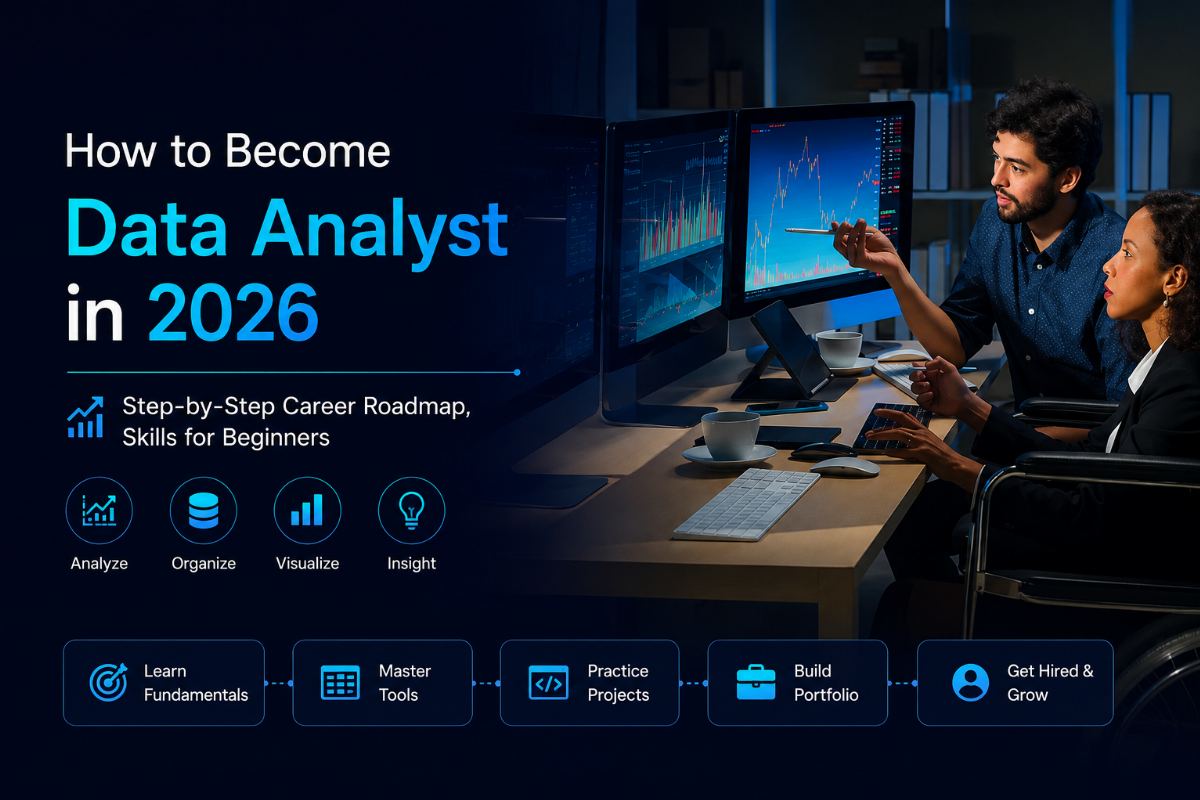
In our hyper-digital world, data is the new oil, but it is raw and unusable without refinement. That is exactly where data analysts come in. They serve as the vital translators who turn messy, chaotic numbers into clear, actionable business strategies. If you have an analytical mind and a passion for solving puzzles, transitioning into data analytics/data analyst courses can completely transform your career trajectory.
This comprehensive guide outlines the exact roadmap, skills, tools, and pathways you need to master to become a successful data analyst.
What Does a Data Analyst Do?
A data analyst is a technical professional responsible for collecting, cleaning, and examining large datasets to identify hidden trends, answer critical business questions, and solve complex operational problems. Far from just staring at rows of numbers all day, these professionals act as corporate detectives. They take raw, unorganized information from various databases, strip away the duplicates and errors through meticulous data cleaning, and use statistical modeling to find meaningful patterns. The ultimate goal of a data analyst is to deliver clear, data-driven narratives that help executives make smart, confident investments and strategic moves.
Why Choose a Career as a Data Analyst?
Choosing a career in data analytics opens the door to immense job stability, rapid professional growth, and highly competitive compensation packages. Because virtually every modern sector—including healthcare, e-commerce, sports, entertainment, and finance—relies on heavy tracking metrics, the demand for analytical talent continues to skyrocket globally. Furthermore, it is an incredibly rewarding field where your individual insights directly influence multi-million dollar business operations, giving you a tangible sense of impact. The role also provides tremendous flexibility, offering thousands of fully remote opportunities and a natural bridge to move into advanced fields like artificial intelligence or data engineering down the line.
Data Analyst Average Salary in USA
The financial rewards for entering this domain are substantial and scale rapidly with your technical expertise. According to comprehensive industry hiring data, the average annual salary for a Data Analyst in the United States sits at $85,613.
However, your exact earning potential is heavily influenced by your geographic location and your years of hands-on experience:
|
Experience Level Data Analyst |
Average Base Salary Range |
|
Entry-Level (0–2 years) |
$58,000 – $75,000 |
|
Mid-Level (3–5 years) |
$78,000 – $108,000 |
|
Senior Analyst (6–9 years) |
$112,000 – $145,000 |
|
Lead / Principal Analyst (10+ years) |
$140,000 – $185,000+ |
Top tech hubs like San Francisco and New York City frequently offer starting averages well over $100,000 to help offset local living costs and attract top-tier analytical talent.
Skills Required for Data Analyst Role
To build a flawless profile that captures the attention of modern recruiters, you must cultivate a balanced mix of technical capabilities and interpersonal strengths:
- Data Cleaning & Wrangling: The ability to spot missing data, remove structural errors, and merge fragmented files into a clean format.
- Statistical Analysis: A solid grasp of descriptive statistics, regression analysis, hypothesis testing, and mathematical distributions to validate your findings.
- Data Architecture Knowledge: Understanding how databases are structured, indexed, and queried without slowing down corporate servers.
- Data Storytelling & Communication: Translating complex mathematical concepts into plain English for non-technical managers and business stakeholders.
- Critical Thinking & Problem Solving: Approaching data with an open mind to discover the underlying "why" behind sudden shifts in company performance metrics.
Tools & Technologies for Data Analyst Training
Mastering the industry-standard software stack is an absolute prerequisite to executing daily analytics tasks efficiently. The core technologies you must learn include:
- Advanced Microsoft Excel: Utilizing pivot tables, VLOOKUP, XLOOKUP, and complex conditional formatting to run rapid exploratory analysis on smaller datasets.
- SQL (Structured Query Language): The undisputed backbone of the industry, used to communicate with, filter, join, and extract data from relational database management systems.
- Python or R Programming: Writing clean scripts using specialized libraries like Pandas and NumPy for complex manipulation, or Matplotlib and Seaborn for advanced statistical charting.
Udemy - Business Intelligence (BI) Platforms: Designing automated, highly interactive visual dashboards using enterprise-level tools like Tableau or Microsoft Power BI.
Step-by-Step Data Analyst Career Roadmap
Breaking into this industry requires a highly structured, deliberate approach to ensure you don't burn out or get lost in theoretical loops:
1. Master Foundations: Month 1.
Build a rock-solid mathematical base by mastering descriptive statistics, probability theory, and exploratory spreadsheet formulas in Microsoft Excel.
2. Conquer Databases: Month 2.
Learn SQL extensively. Practice writing complex multi-table JOINs, subqueries, and window functions on platform sandboxes like LeetCode or HackerRank.
3. Learn Programming & BI: Months 3-4.
Pick up Python basics for data manipulation. Simultaneously, master either Power BI or Tableau to convert static spreadsheets into fully dynamic corporate dashboards.
4. Build a Live Portfolio: Month 5.
Download unique datasets from Kaggle. Clean the data, extract insights, build a dashboard, and publish your complete interactive projects openly on GitHub.
5. Apply & Network: Month 6.
Optimize your resume and LinkedIn profile to highlight your technical stack. Apply for entry-level internships or junior roles while actively networking with analytics managers.
Difference: Data Analyst vs. Data Scientist vs. Data Engineer
It is incredibly common for beginners to confuse the primary roles within a modern corporate data department. While these three professions collaborate closely daily, their core focus, infrastructure responsibilities, and market compensation rates vary drastically:
|
Feature / Metric |
Data Analyst |
Data Scientist |
Data Engineer |
|
Core Focus |
Analyzing past data to answer specific business questions. |
Building predictive ML models to forecast future trends. |
Designing pipelines and infrastructure to move/store raw data. |
|
Primary Tools |
SQL, Excel, Tableau, Power BI |
Python, R, TensorFlow, Spark |
SQL, Python, AWS, Spark, Airflow |
|
Math Focus |
Descriptive Statistics |
Advanced Math & Machine Learning |
Data Structures & Algorithms |
|
Mid-Level US Salary |
$78,000 – $108,000 |
$120,000 – $145,000 |
$125,000 – $155,000 |
[Also Read: How to Become a Data Scientist: Complete Learning Path, Career Roadmap, Future Scope & Salary]
Data Analyst Certifications to Consider
Earning a globally recognized, standardized industry credential is an exceptional way to validate your skills to recruiters if you do not hold a formal computer science or mathematics degree. The most respected certifications on the market include the Data Analytics Professional Certificate, which provides an exceptional end-to-end framework for absolute beginners. For tool-specific mastery, the Microsoft Certified: Power BI Data Analyst Associate or the Tableau Desktop Certified Associate credentials hold immense weight across corporate hiring desks. Alternatively, the CAP (Certified Analytics Professional) offers a fantastic, platform-agnostic certification focusing deeply on high-level business problem-solving methodology.
Data Analyst Learning Path for Beginners
When you are starting completely from scratch, consistency beats intensity every single time. Begin your daily learning habit by spending 45 minutes working inside basic Excel spreadsheets, understanding how data filters and basic aggregates operate. Once comfortable, transition entirely to writing raw SQL select statements, slowly increasing the difficulty over two weeks to encompass complex table aggregates and data mutations. From there, merge your database skills with a visualization tool so you can see how backend tables directly power corporate charts. Finally, cap off your education path by automating your data ingestion tasks using Python scripts, ensuring your skills mirror the exact expectations of a fast-paced corporate environment.
[Also Read: Aspiring to Become a Data Engineer? Complete Learning Path, Career Roadmap & Certifications Needed]
Data Analyst Interview Questions for Beginners
Preparing thoroughly for your very first technical screening loop will dramatically reduce your anxiety and maximize your job offer success rate. Be ready to face these common entry-level interview questions for data analyst course:
- Technical SQL: "What is the structural difference between a LEFT JOIN and an INNER JOIN, and can you write a query to find duplicates in this user table?"
- Data Cleaning Scenario: "Walk me through your exact process when handling a massive dataset that has up to thirty percent of its key demographic values missing."
- Statistical Theory: "Can you explain what a P-value means in plain, simple terms to an executive who has never taken a mathematics course?"
- Behavioral Alignment: "Describe a time when your analytical data findings directly contradicted what your project manager or team lead expected to see."
Data Analyst Career Prospects & Future Scope
The long-term career outlook for data experts is phenomenally secure, with the US Bureau of Labor Statistics projecting analytics roles to grow 23% over the next decade, a rate deemed much faster than the national average for all professions. As automation, generative AI, and cloud data warehouses expand rapidly, business operations are generating more tracking points than human teams can keep up with. Far from replacing human analysts, advanced AI tools are supercharging them, allowing professional analysts to offload mundane cleaning tasks and spend their time focusing deeply on high-level strategic data architecture. Entering this vertical equips you with highly portable skills that can easily transition you into Senior Management, Analytics Engineering, or AI specializations.
Vaanii.com Recommended Data Analyst Courses
For learners seeking a highly structured, practical, and mentor-guided academic curriculum, Vaanii.com provides world-class technology paths featuring their signature "Where Learning Meets LOL" tech-driven interactive pedagogy, boasting an outstanding 98% placement success rate:
- SQL Level-0 to Level-4 Program: A comprehensive, multi-tiered live and on-demand track that guides you smoothly from absolute database ground zero up to advanced query optimization, partition schemas, analytical window functions, and rigorous real-world interview simulations.
- Informatica Enterprise Learning Path: A deep-dive architectural program focusing extensively on production-grade Enterprise ETL (Extract, Transform, Load) workflows, filter transformations, lookup strategies, and complex data warehousing methodologies.
Vaanii.com - AI/ML & Data Science Track (Python & PySpark): The perfect advanced specialization course designed to help intermediate analysts master large-scale big data manipulation, automated data cleaning scripts, and scalable predictive modeling.
Frequently Asked Questions
Q1: Can I become a data analyst without a formal college degree?
Yes, absolutely. The data analytics industry values proven technical capability, practical portfolio projects, and problem-solving skills far above expensive university degrees. Building a robust GitHub repository packed with real-world case studies can easily bypass traditional HR filters.
Q2: Which programming language is better for data analysts: Python or R?
Python is generally the superior choice for modern data analysts due to its immense versatility, straightforward readability, and widespread adoption across corporate tech stacks. While R is incredible for pure academic statistical research, Python integrates much better with cloud engineering systems.
Q3: How long does it typically take to become job-ready as a beginner?
With a focused, structured study schedule of roughly 10 to 15 hours per week, most dedicated beginners can successfully acquire all the core technical proficiencies and build a competitive interview portfolio within 5 to 6 months.
Q4: Is data analytics a highly math-intensive career path?
Not drastically. You do not need a background in advanced calculus or differential equations to excel. You simply need a comfortable, confident grasp of foundational high-school level mathematics, descriptive statistics, averages, percentages, and basic data distributions.
Q5: What is the single biggest mistake beginners make when studying?
The most common mistake is falling into "tutorial hell"—constantly watching course videos sequentially without ever opening a code editor or database terminal to build independent projects from scratch. True learning happens when you run into errors and debug them yourself.
Q6: Will AI replace data analysts?
No, AI won't replace data analysts; it supercharges them by automating mundane cleaning so they can focus on high-level strategy. The field is projected to grow 23% over the next decade.
Conclusion
Becoming a data analyst is an incredibly achievable and life-changing career shift that rewards curiosity, structured thinking, and practical execution. By systematically mastering SQL, excel, a visualization platform, and a structured learning path like the expert-led tracks on Vaanii.com, you can comfortably transition from an absolute beginner into a highly paid, high-impact data professional. Stop overthinking the roadmap, choose a foundational course, and start querying your very first dataset today
Discussion
Be the first to share your thoughts.